Everything You Need To Know About I Beam in Construction.
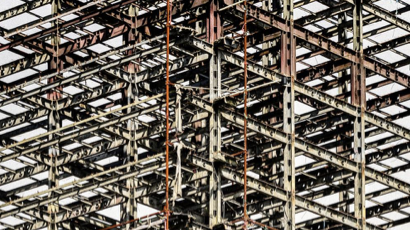
I Beams, also known as universal beams, are an important component of modern building all over the world. Despite the introduction of newer beam variations such as W Beams and Concrete Beams, they are still commonly utilized.
Let’s learn more about I Beams and their importance in the building business throughout the years.
But first, as is customary for the uninformed,
What are Beams in Construction?
Beams are structural elements used to support axial loads such as a floor or roof.
Traditionally, wood/timber was used as beams, but in the current day, wrought iron, steel, and other metals, such as concrete, are employed.
What are the different sorts of Beams?
Beams can be fixed, trussed, overhanging, double overhanging, simply supported, cantilever, spring supported, and so on.
What is an I Beam?
The I Beam is the most common structural steel beam used in modern construction. They are also known as universal beams and can be classified as H, W, and so on.
It is also recognised as the most useful beam in the building business due to its incredible capacity to carry heavy loads and versatility.
Who created I Beam?
In 1849, Alphonse Halbou was granted a patent for I beams made of wrought iron, and Henry Grey created the rolling process that enhanced the I beams.
An I Beam Design
An I Beam is a long piece of structural steel with two horizontal planes called flanges joined by a steel portion in the center; therefore, sideways, it seems like a single continuous piece of steel, and straightways (in the cross section), it resembles the letter “I” or “H.”
This unique construction prevents the beam from splitting in two and instead bends it. This straightforward design is also a very cost-effective technique of producing steel.
What are the different types of I Beams?
Certain metallic or steel beams can be classified as I beams due to their comparable construction.
H Beams: H Beams can be regarded as a subtype of I Beams because they appear to be quite similar to I Beams. They are also known as bearing piles and have the same thickness all throughout as I beams but with wider legs.
W Beams: W beams are yet another beam that is commonly employed as an I beam. The thickness of W beams is not regular, and in cross section, they resemble W. W beams are commonly used as guardrails on highways. Thrie beams are another name for them.
What are the various metals and materials used to create I beams?
Steel I beam, stainless steel I beam, galvanized I beam, concrete I beam, fiberglass I beam, carbon fiber I beam, plywood I beam, and the old school wrought iron I beam are all employed in the building of I Beams nowadays. However, structural steel is the most commonly used.
What are the advantages of using an I Beam?
I beams have various advantages, including high load bearing capacity, angular momentum, reusable material (steel), vibration dampening, and a wide range of diameters.